

“You’re not good enough.”
For many of us, this phrase feels all too familiar. But if you’ve ever experienced that inner whisper of doubt, know this: you’re not alone. Many women — especially entrepreneurs and leaders — struggle with imposter syndrome: the quiet but persistent feeling that our accomplishments are more about luck than skill. Even in the face of clear success, we question our abilities and feel like frauds pretending to belong.
For trailing spouses, that whisper doesn’t just echo. Real-life experiences of invisibility, disconnection, and career disruption amplify it.
Unexpectedly a trailing spouse
I didn’t set out to become a “trailing spouse.” In fact, I didn’t even realize that’s what I would be called. At the time, my husband and I had been married for four years and were based in Virginia. I was working as a management consultant, in the middle of my master’s program, and had just welcomed our second child. When my husband decided he needed a career change, I was fully supportive.
I embraced all the potential changes with hope, optimism, and, admittedly, a touch of naivety. I thought, “I like to travel. We have friends abroad. We can make this our lifestyle.” It never entirely occurred to me that I would be defined as a “trailing spouse.”
My husband entered the Foreign Service in 2012, and at first very little changed for me. After his initial training, his first posting was in Washington, D.C. — a transition that left our family’s routine largely intact. He continued handling daycare drop-offs, while I balanced my career in management consulting with a mix of telework, office days, and occasional travel. During that time, I was able to remain in the same role, earn a promotion, and complete my master’s program. My husband was thriving in his new role, and since we’ve continually prioritized doing work we love, our employment situations felt like a win-win. Since I’ve always worked remotely in some capacity, I assumed that when the time came to move, I’d simply continue my work from the new location. I also thought (perhaps too confidently) that something meaningful would always find me professionally.
But that assumption began to shift once we moved overseas.
After two years in Washington, D.C., we received orders for our first overseas post: Brasília, arriving in Summer 2014. While I was genuinely excited, I quickly began to sense a shift. It wasn’t the logistics of moving or settling in; we managed those quite well. The change was more subtle — a quiet erosion of visibility, both socially and professionally. By the end of that first year, however, the impact had become undeniable.
Determined to stay positive, I brushed off the warnings from other trailing spouses who had faced remote-work challenges abroad. But as the weeks passed and I settled into my new reality, those cautions began to echo in my mind. Back home, I’d been the colleague invited to pitch meetings, strategic sessions, and client deep dives. Only after leaving did I realize how much my in-person presence fueled my opportunities. Overseas, that presence had disappeared — and with it, the spontaneous invitations. No longer “in the room,” I felt creeping doubts: Am I still relevant? Am I still seen as a leader?

This wasn’t just in my head — it was structural. The quiet erosion of visibility I had noticed — being thousands of miles away, working across time zones, and adapting to a new culture — naturally moved my name off people’s radar. And yes, there were wonderful opportunities overseas. Our family embraced new languages, friendships, and cultural experiences; even our elementary school-aged kids and our dog became part of the adventure. But those benefits enriched us as a family, not me as a professional. As a trailing spouse, you can enjoy the richness of the experience, but for me it didn’t carry the same weight as building a career that was wholly my own.
I also found myself surrounded by incredibly talented spouses, many of whom were struggling with the same questions of identity and worth. Hearing their doubts often echoed my own. I was learning, growing, and adapting in countless ways, but not always in ways that translated into professional recognition where it mattered most. Over time, that fading presence — the sense of being present in life but absent from the professional stage — opened the door to something I hadn’t expected: imposter syndrome.
Overcoming imposter syndrome
Imposter syndrome doesn’t announce itself; it seeps in, thriving where external validation has worn thin. And as a trailing spouse, that absence can feel relentless. We’re often forced to choose between rebuilding our careers with every move or reshaping our current work around circumstances that don’t quite fit. Both paths are inherently unstable, with plenty of fertile ground for self-doubt. Add cultural transitions, visa restrictions, and the loss of a local network, and even the most capable among us can start to question our place.
I thought remote work would shield me from this. I was still working as a management consultant with two primary U.S.-based clients. My role centered on project management and implementation — bridging policy and technology solutions and ensuring clients could execute on strategy. It was challenging, rewarding work. In many ways, I was able to continue delivering; I assumed staying in my lane and doing good work would be enough. But I underestimated how much I relied on being seen. One of the best pieces of advice I ever received was from a spouse who had built a thriving telework business, who told me that maintaining visibility would be the hardest part. I didn’t fully understand her then. Years later, I know exactly what she meant.
Reflecting on my relocation using the Gupte Scale, Brasília ranked 9 out of 15. This was a good location with solid resources, but professionally, the timing was challenging. The move disrupted the steady rhythm I had built in D.C., and I had to be more intentional about staying connected and visible. While it required rethinking my approach to work, it also pushed me to develop new strategies to sustain momentum from a distance.
Choosing my own professional path
In Summer 2015, halfway through our two-year tour, and after lots of self-reflection, I began to ask myself some hard questions: Were the travel and experiences worth it? Was supporting the mission of diplomacy — even tangentially — more important than continuing to build my own identity and career?
So, I made a shift. I got intentional. I stopped waiting to be remembered and started building something that didn’t depend on location or proximity. I returned to Virginia and have remained based there ever since. That repatriation was unexpectedly difficult, as I balanced rebuilding my support systems at home while reestablishing myself professionally. Following three consecutive tours in Washington, D.C., my husband took on an overseas tour in Frankfurt, Germany. I made the difficult decision to stay in D.C. with our children, then in middle and high school. It wasn’t always easy, but it was the balance that allowed both of us to honor our paths.
That doesn’t mean I don’t believe in the mission of diplomacy; I do, deeply. But I had to acknowledge that my mission mattered, too.
Brasília was my first and only experience living overseas as a trailing spouse, but it shaped me profoundly. And while I never returned to a permanent post abroad, I’ve continued to spend extended time in Europe in recent years while my husband was based there. I”ve come to realize that the very things that once made me feel “less than” in a traditional work environment — mobility, career gaps, and a nonlinear path — are sources of strength for me, my team, and our clients. They’ve shaped us into a resilient, empathetic, and adaptable talent pool, poised for great things.
In 2019, I began testing the idea of creating a business model designed for flexibility and global collaboration. By 2020, I had formally launched LVL-Up Strategies, a consulting firm built on mission, adaptability, and the power of remote work. Today, we’re a borderless, asynchronous team (including many trailing spouses) serving clients across sectors and around the globe.
Advice for trailing spouses facing imposter syndrome
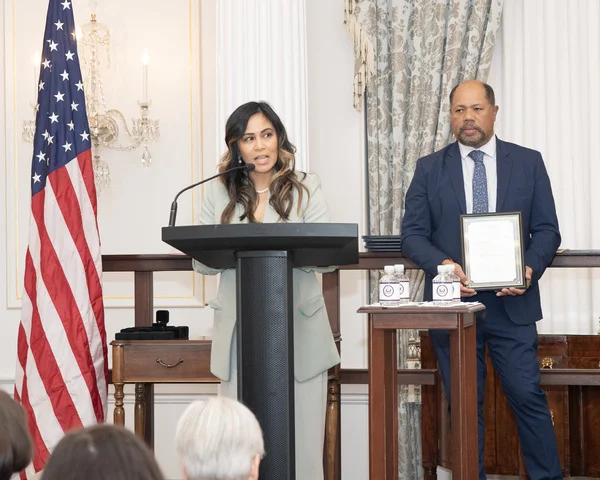
If you’re in a season of self-doubt or wondering how to find yourself again amid the moves and career disruptions, here are five lessons I’ve learned as an entrepreneur, mother, and trailing spouse. These are not just action steps — they’re ways to prove to yourself that you belong exactly where you are and to strengthen your confidence muscle over time.
- Redefine Success. Your success doesn’t need to look like it used to. It doesn’t need to match anyone else’s version either. Whether it’s launching a small business, consulting from afar, learning a new language, or simply sustaining your family through a tough post—that counts. Every win is proof you belong in the space you’ve created.
- Mine Your Hidden Strengths. Global relocation develops skills people pay to learn: cross-cultural communication, logistics under pressure, emotional intelligence, and resilience. Don’t dismiss what you’ve done just because it wasn’t in a formal job description. Own them. These are the building blocks of your confidence, not just lines on a resume.
- Acknowledge the Visibility Gap. One of the hardest parts of overseas life is becoming invisible professionally. Name it. Then find ways to counter it—stay connected with former colleagues, show up online, speak on panels, or create your own visibility through new platforms. Every visible action is a rep for your confidence muscle.
- Stay in Motion. You don’t need to have it all figured out on day one or even year ten! But don’t stand still; forward movement matters. Volunteer, pitch a freelance service, take a course, or host a webinar. Every step forward creates momentum and quiets the “you’re not good enough” noise in your head.
- Choose Yourself. There may come a moment when you realize that your partner’s mission, while important, can’t replace your own. That’s not selfish — it’s essential. Your work, your identity, and your purpose matter.
You’re not on hold — you’re in progress
I didn’t enter the foreign service lifestyle with a master plan or a clear vision of what I’d become. But every challenge — the isolation, the invisibility, the identity shifts — turned out to be an invitation. An invitation to define success on my own terms, to mine the skills I’d gained, and to put them to work in ways that fit my life, not the other way around.
You can build a meaningful career from anywhere. You can lead from the margins. You can thrive without asking permission.
So, when that “you’re not good enough” whisper creeps in, I hope you answer it the way I’ve learned: I’ve moved countries, built a business, raised a family, navigated bias, and rebuilt again. I’m more than good enough. I’m unstoppable.

1 comment
Bravo Rona!!
Well captured and explained. Thank you for taking the time to write about what is not so easy to spell!! Trailing spouses are resilient and have the gift to reinvent, but that requires tough decisions.
Comments are closed.